This page is for Strapi users rethinking where they host, now that Strapi Cloud has no free plan, and for anyone choosing between the two. It shows where each one fits, what each costs and what a move takes. If LyEve is new to you, what LyEve is covers it in one page.
LyEve wrote this comparison. Every fact about Strapi links to the Strapi page it came from, and each page was read on October 11, 2026.
The short answer
| LyEve | Strapi | |
|---|---|---|
| License | MIT for the engine and the admin console. Three parts are commercial: the license verification in the engine image, every plugin under the Plugin EULA (31 of the 51 free), and the admin image's visual flow and schema editors | MIT for the Community Edition. Code under ee/ directories is the Enterprise Edition, under its own license |
| Databases | PostgreSQL, MySQL, SQL Server | MySQL, MariaDB, PostgreSQL, SQLite |
| How it runs | The engine is one Go container from a published image. The admin console is a second container, on Node | A Node.js app you build, on Node 22, 24 or 26. Strapi publishes Dockerfile examples, not an official image |
| Changing content types | In the admin console or the API, on a running instance | In development, as files in your codebase, then deployed |
| Several sites in one install | One tenant free. More need Enterprise, $119 a month | Strapi recommends one Strapi per site or client |
| Free self-hosted tier | Three admin accounts and one tenant, with no cap on content types | Community, with unlimited entries and API calls |
| Lowest paid self-hosted plan | Starter, $4 a month | Growth, $45 a month with 3 seats, and $15 a month for each extra seat |
| Hosting by the vendor | None. You run it | Strapi Cloud, from $35 per project a month. Its Free plan closed to new projects on July 1, 2026 |
| GraphQL | An add-on at $3 a month, included from Pro | Included in Community |
| Single sign-on | SAML at $15 a month or in Enterprise, beta, with a settings page in the admin console | An add-on to Growth at $150 a month, included in Enterprise |
Where Strapi is the better choice
- Its community and marketplace are far larger. The Strapi repository dates from September 2015 and has more than 73,000 stars on GitHub. Its marketplace lists plugins and integrations from that community. LyEve is new.
- It runs on MariaDB and SQLite. LyEve does not list MariaDB and does not run on SQLite. SQLite lets you start a project with no database server at all.
- GraphQL is free. Strapi's Community edition includes REST and GraphQL. LyEve's GraphQL API is a $3 a month add-on, included from the Pro plan.
- The vendor can host it. Strapi Cloud runs your project for you, from $35 per project a month. We sell no hosting.
- Your content model lives in your codebase by default. Strapi stores each content type as a file, so a model change goes through review and deploys with the code.
Where LyEve is the better choice
- It runs on SQL Server. LyEve runs on PostgreSQL, MySQL or SQL Server. As of October 2026, the databases Strapi supports do not include SQL Server.
- One install can serve several sites. A free install runs one tenant. With Enterprise, each client gets a tenant with its own content types, entries, media, users, API keys and settings.
- Content types change on a running instance. You add or rename a field in the admin console, and the site keeps serving while the change applies. Strapi's FAQ says there is no plan to allow model changes in production.
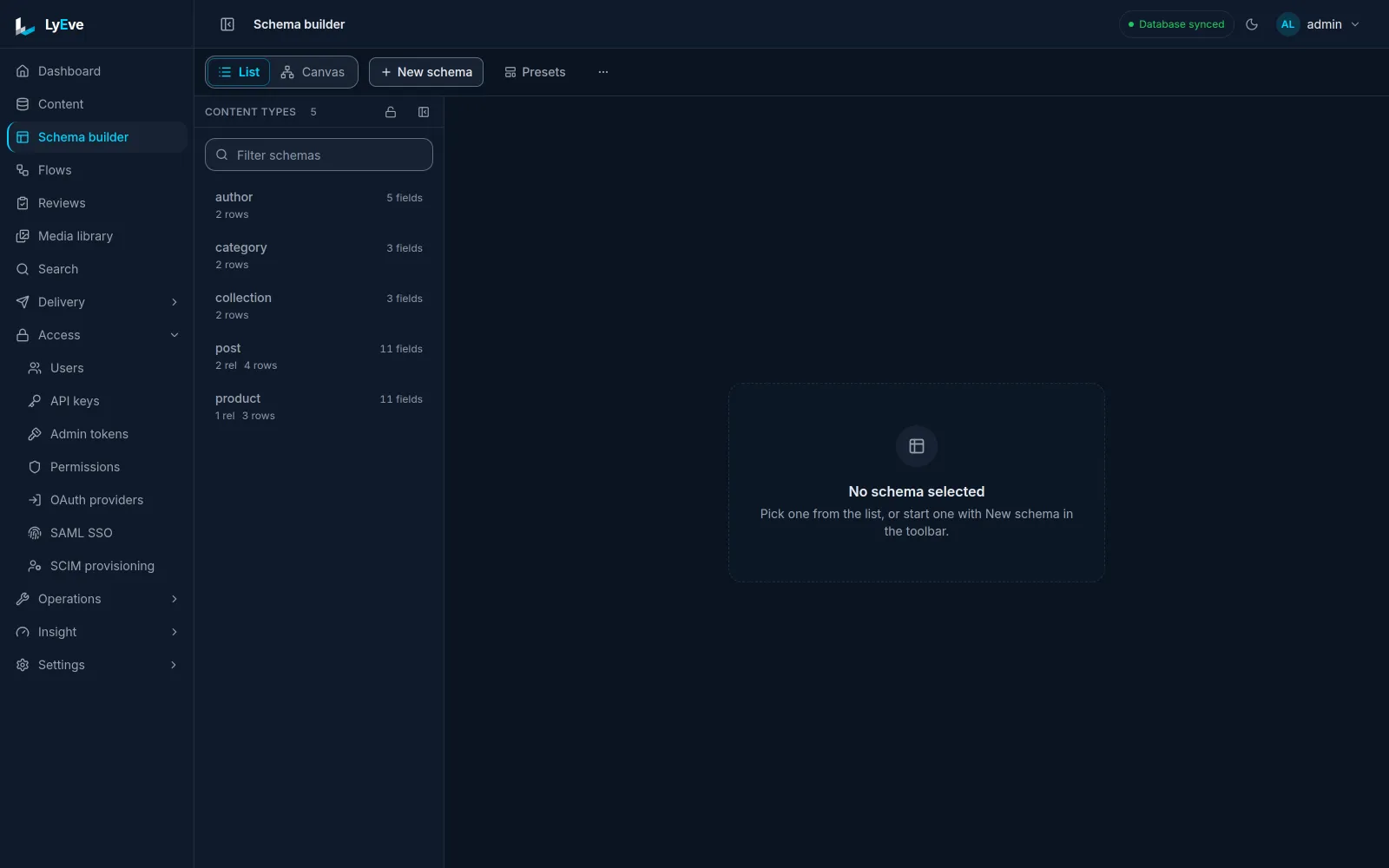 The schema builder's List view, with the content types of a running instance.
- The engine ships as an image. You run
ghcr.io/lyeve-labs/lyeve-coreand point it at a database. There is no project to build before you deploy. - The paid steps are small. LyEve's plans are $4, $15, $39 and $119 a month, and add-ons are sold one at a time.
License
As of October 2026, Strapi's license file grants the MIT license for the Community Edition. Code under an ee/ directory is the Enterprise Edition, under a separate license, and Strapi's pricing page lists Community as "Open-Source under MIT License".
LyEve's engine and admin console are MIT. Three parts are commercial: the license verification in the engine image, the visual flow and schema editors in the admin image, and every plugin, the free ones included, which ships under the Plugin EULA. That is a commercial license, so a free plugin is free of charge, not open source.
The EULA forbids redistributing or modifying a plugin, and using one to provide a hosted service that competes with LyEve Labs without a reseller agreement. The source code page lists which part of each image is under which license.
Databases
Both run on PostgreSQL and MySQL. LyEve adds SQL Server. Strapi adds MariaDB and SQLite, and its database page says it does not support MongoDB or other NoSQL databases.
Running it
Strapi is a framework, so you build a Node.js project and deploy it. Its docs support the Active and Maintenance LTS releases of Node, 22, 24 and 26 as of October 2026. Its FAQ explains why there is no official Docker image: "A single Docker image cannot cover all use cases, so Strapi provides Dockerfile examples instead."
LyEve's engine is one Go container that serves the Admin API and the Content API. The admin console runs beside it in a second container, a SvelteKit app on Node, also published as an image. The engine needs a PostgreSQL, MySQL or SQL Server database. Neither container needs a build step on your side.
Price, worked through
Take an agency with three client sites, each with its own content and its own editors, self-hosted.
Strapi. Strapi's guide to multi-tenancy says "The recommended approach: one Strapi per site or client." That means three Strapi projects:
- Self-hosted on the Community edition, the licenses cost $0, and you deploy and update three projects.
- On Strapi Cloud's Starter plan, 3 times $35 is $105 a month, or 3 times $348 is $1,044 a year on yearly billing.
LyEve. One install with three tenants. A free install runs one tenant, and more than one needs Enterprise:
- Enterprise is $119 a month, or $1,190 a year paid annually, with the rest of that plan included.
Each client keeps its own content, users and settings, and you deploy and update one install.
The cheapest path is still free on both sides. Three free LyEve installs, one per client, cost nothing, the same as three Strapi Community projects. Enterprise buys running them as one.
Moving from Strapi to LyEve
A move has two parts: the content types, then the entries. The tools for both are free on every install.
- Convert the content types. Send your Strapi
schema.jsonfiles to LyEve's schema import with the Strapi converter. Strapi keeps them undersrc/api/, one per content type. Read the plan it returns, then apply it. Send them together, so a relation keeps its target. A component or dynamic zone becomes a JSON field, an enumeration becomes a text field whose values are not enforced, and every renamed field is listed before anything is written. - Export the entries, by one of two routes:
- The REST API. Strapi 5's REST API returns each entry's fields directly in its
dataarray, so save that array as a JSON file, one content type at a time. Each response holds one page, 25 entries by default, so request every page. Relations and media need Strapi'spopulateparameter, because the REST API leaves them out by default. - The
strapi exportcommand. It writes an archive of JSON Lines files, but each line wraps an entry with its content type, so flatten the lines by content type before you import them.
- The REST API. Strapi 5's REST API returns each entry's fields directly in its
- Import them. In the LyEve admin console, open Insight, then Imports, and choose New import. Map the columns, run the dry run, then import. A finished import can be rolled back.
- Bring the rest across. Media files move separately, through the media library. Strapi's export leaves out admin users and API tokens, so create those again.
The migration guide walks through moving a Strapi article type and its entries, request by request.
Questions
Is there still a free way to run Strapi?
Yes. The Community edition is free to self-host under MIT. Strapi Cloud closed its Free plan to new projects on July 1, 2026, and Strapi set September 1, 2026 as the date existing free projects would be deleted. As of October 2026, Cloud plans start at $35 per project a month.
Does LyEve have a free trial?
No. There is no trial. The free tier is how to try LyEve, and it runs on your own server with no license key.
Can LyEve run on SQLite?
No. LyEve needs PostgreSQL, MySQL or SQL Server.
Does LyEve need Node?
The engine does not. It is a Go program in one container. The admin console is a Node app, shipped as its own container image.
Can I keep my content model in Git, as with Strapi?
Yes. Content types can be declared in lyeve.yaml beside your settings and are applied when the engine starts. A content type the file does not mention is left alone, so you can keep some types in the file and manage others in the admin console. See content type portability.
Start LyEve in one command
With a PostgreSQL database and a user ready for LyEve, this starts the engine on the free tier:
docker run -d --name lyeve-engine \
  -e APP_ENV=development \
  -e DATABASE_URL="postgres://lyeve:<password>@db.example.com:5432/lyeve?sslmode=require" \
  -e JWT_SECRET="$(openssl rand -hex 32)" \
  -e ENCRYPTION_KEY="$(openssl rand -hex 32)" \
  -p 3001:3001 -p 3002:3002 \
  ghcr.io/lyeve-labs/lyeve-core:latest
With no database yet, the quickstart starts PostgreSQL and the engine together. The pricing page lists every plan and add-on, from Starter at $4 a month.
Sources
- Strapi license, read 2026-10-11
- Strapi CMS pricing, read 2026-10-11
- Strapi Cloud pricing, read 2026-10-11
- We're removing the Free plan from Strapi Cloud, read 2026-10-11
- Strapi Cloud usage and billing, read 2026-10-11
- Strapi database configuration, read 2026-10-11
- Strapi deployment, read 2026-10-11
- Strapi FAQ, read 2026-10-11
- Multi-tenancy in Strapi, read 2026-10-11
- Strapi data export, read 2026-10-11
- Strapi REST API, read 2026-10-11
- Strapi populate and select, read 2026-10-11
- Strapi sort and pagination, read 2026-10-11
- Strapi marketplace, read 2026-10-11
- Strapi on GitHub, read 2026-10-11