This page is for developers and agencies choosing between LyEve and Directus, and for Directus users weighing its 2026 license change. It shows where each one fits, what each costs and what a move takes. If LyEve is new to you, what LyEve is covers it in one page.
LyEve wrote this comparison. Every fact about Directus links to the Directus page it came from, and each page was read on October 11, 2026.
The short answer
| LyEve | Directus | |
|---|---|---|
| License | MIT for the engine and the admin console. Three parts are commercial: the license verification in the engine image, every plugin under the Plugin EULA (31 of the 51 free), and the admin image's visual flow and schema editors | Monospace Sustainable Core License 1.0. Each version becomes available under GPL-3.0 four years after its release |
| On the Open Source Initiative's list of approved licenses | Yes, MIT is | No |
| Free use | Any organization, commercial use included, with no revenue or staff threshold | Core, within its limits. Free commercial use comes through a grant for organizations under $5 million in annual revenue and fewer than 50 employees |
| Free tier limits | Three admin accounts, one tenant, and twenty flows per tenant on the nodes that stay inside the instance. No cap on content types | 3 seats, 25 collections and 5 flows |
| Lowest paid plan | Starter, $4 a month or $40 a year | Team, $499 a month on an annual commitment, or $599 month to month |
| Databases | PostgreSQL, MySQL, SQL Server | PostgreSQL, MySQL, SQL Server, Oracle, SQLite, CockroachDB |
| How it runs | The engine is one Go container. The admin console is a second container, on Node | One Docker image, built on Node 22 |
| Hosting | You run it. We sell no hosting | Self-hosted on every tier, or Directus Cloud at $99 a month on Core and Team |
| Extensions | 51 plugins in the image | A marketplace in the Studio that lists extensions published to npm |
| What it sends to the vendor | A free install, and an install with a signed license token, make no call to us. A license key is exchanged with our license server for a signed token once, and again only to renew it | A usage report every six hours. Some licenses do not allow turning it off |
Where Directus is the better choice
Choose Directus when one of these matters to you.
- You run Oracle, SQLite or CockroachDB. As of October 2026, Directus connects to six databases, three more than LyEve. LyEve needs PostgreSQL, MySQL or SQL Server.
- You want a CMS over tables you already have. Directus registers tables created directly in your database as collections, so it can sit on top of an existing schema.
- You want a long track record and a large community. The Directus repository dates from December 2012 and has more than 38,000 stars on GitHub. LyEve is new.
- You want extensions from a marketplace. The Directus Marketplace installs extensions from the Studio's settings, and it lists every extension published to npm.
- You want the vendor to host it. Directus Cloud is an add-on at $99 a month on Core and Team. We sell no hosting.
Where LyEve is the better choice
- The engine and the admin console are MIT. MIT is on the Open Source Initiative's list, and it sets no revenue or staff threshold. The engine runs with no license key at all. The source code page names the parts that are commercial.
- The price climbs in small steps. LyEve's plans are $4, $15, $39 and $119 a month. As of October 2026, Directus publishes no plan between Core at $0 and Team at $499 a month.
- The free tier sets no cap on content types. A free install holds three admin accounts, one tenant and as many content types as you need. Directus Core holds 25 collections.
- A free install makes no call to us. The license check runs on your machine, and the License section below says when a licensed install calls us.
License
As of October 2026, Directus's license is the Monospace Sustainable Core License, version 1.0. It replaced the Business Source License in the Directus repository on May 28, 2026. Its grant reads:
A Permitted Purpose is any purpose other than a Competing Use.
It defines the exception this way:
A Competing Use means making the Software available to any party (on a stand alone basis or together with your products or services) that competes with the Licensor's commercial offerings of the Software itself, where Licensor imposes a license fee, royalty, or other charge for exercise of any rights to the Software.
Directus's licensing page adds: "Free commercial use is available through the Open Innovation Grant for entities with less than $5M in annual revenue and fewer than 50 employees." Each version also becomes available under GPL-3.0 on the fourth anniversary of its release.
LyEve's engine and admin console are MIT. Three parts are commercial: the license verification in the engine image, the visual flow and schema editors in the admin image, and every plugin, the free ones included, which ships under the Plugin EULA. That is a commercial license, so a free plugin is free of charge, not open source.
The EULA forbids redistributing or modifying a plugin, and using one to provide a hosted service that competes with LyEve Labs without a reseller agreement. The source code page lists which part of each image is under which license.
A free install, and an install with a signed license token, make no call to us. The license check runs on your machine. A license key is exchanged with our license server for a signed token once, and again only to renew it. That is the only call the engine makes to us.
Databases
LyEve runs on PostgreSQL, MySQL or SQL Server. As of October 2026, Directus runs on all three, plus Oracle, SQLite and CockroachDB. If SQL Server is why you are looking, both products run on it.
Running it
LyEve's engine is one Go container that serves the Admin API and the Content API. The admin console runs beside it in a second container, a SvelteKit app on Node. The engine needs a PostgreSQL, MySQL or SQL Server database.
Directus ships as one Docker image built on Node 22, and its requirements page asks for an environment that runs Docker.
Price, worked through
Take a company above Directus's grant thresholds, with five people who work in the admin console and 30 content types, self-hosted.
Directus. Five people need five seats, and 30 content types need 30 collections. Core allows 3 seats and 25 collections, so the company needs Team, which includes 10 seats and 50 collections:
- On an annual commitment, 12 times $499 is $5,988 a year.
- Month to month, 12 times $599 is $7,188 a year.
LyEve. Editing content in the admin console takes an admin account, and a free install holds three. Any license lifts that ceiling, and content types have no cap, so Starter covers the team:
- Paid annually, Starter is $40 a year, ten months for twelve.
- Month to month, 12 times $4 is $48 a year.
On these numbers, LyEve costs $5,948 a year less than Directus Team billed annually: $5,988 minus $40.
If the company qualifies for Directus's grant, Directus costs nothing to self-host, and LyEve still costs $40 a year for the fourth and fifth admin accounts.
Starter does not include every feature. Full-text search ($8 a month), GraphQL ($3), realtime ($8) and content releases ($3, beta) are add-ons, each included from Pro at $15 a month. The pricing page lists every add-on and plan.
Moving from Directus to LyEve
A move has two parts: the content types, then the entries. The tools for both are free on every install.
- Rebuild the content types. LyEve's schema import converts definitions from JSON Schema, OpenAPI, Strapi, Contentful and WordPress. It has no converter for a Directus schema snapshot, so recreate each collection in the schema builder, or write the content types as a YAML file and import it with a dry run. See content type portability.
- Export the items. In Directus, open a collection, choose Import / Export in the sidebar, then Export Items. Pick CSV, JSON or YAML. Directus also offers XML, which LyEve does not read.
- Import them. In the LyEve admin console, open Insight, then Imports, and choose New import. Pick the file and the content type, check the column mapping, and run the dry run before you import. A finished import can be rolled back. See bulk import.
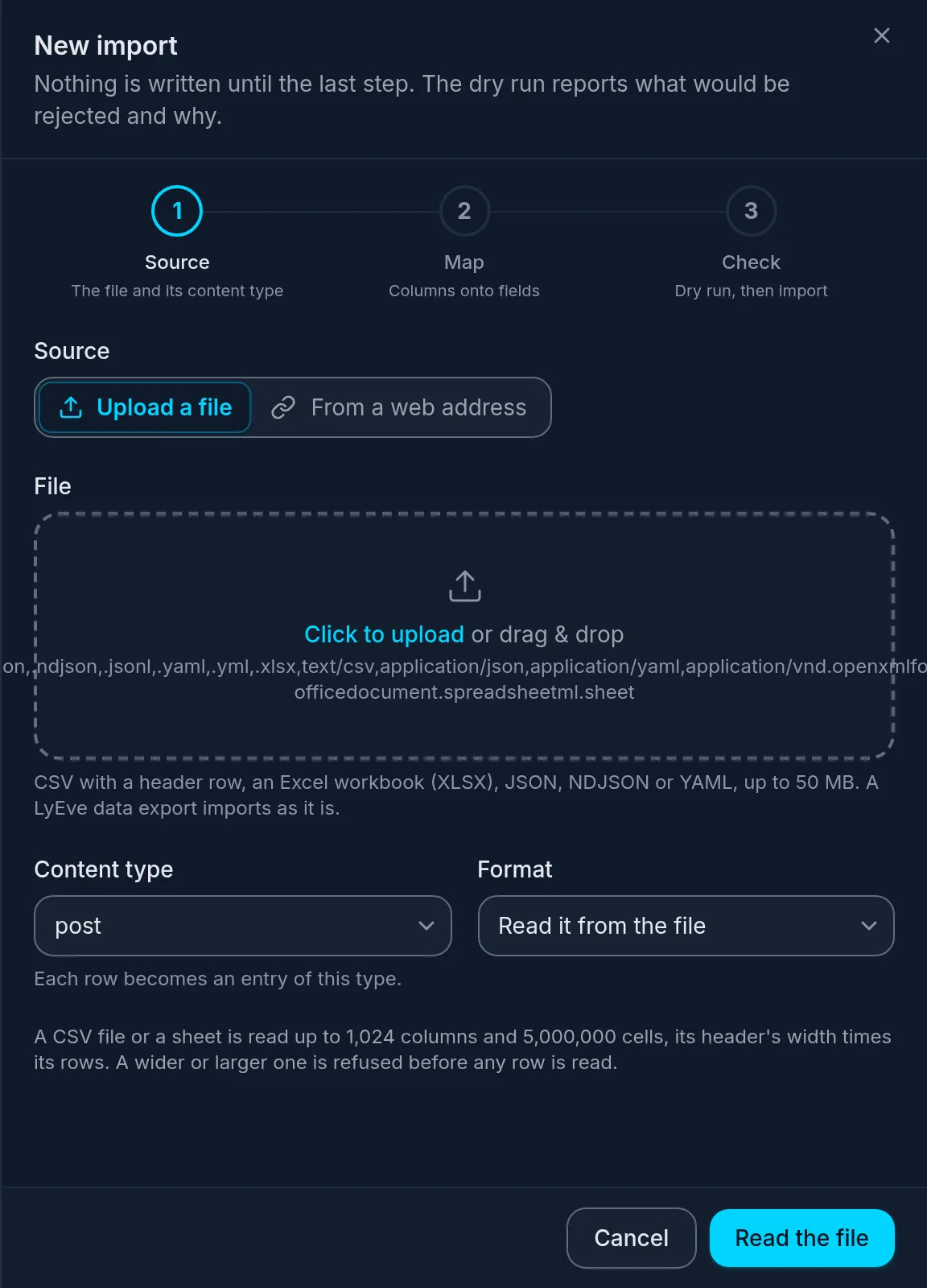 The New import dialog at its Source step, which takes CSV, Excel, JSON, NDJSON or YAML files.
- Rebuild what an item export leaves behind. Relations export with Directus's ids, so relink them after the move. Files, users, roles, flows and extensions do not travel in an item export.
The migration guide shows the same steps over the API.
Questions
Is Directus open source?
As of October 2026, Directus's source is public under the Monospace Sustainable Core License, which is not on the Open Source Initiative's list of approved licenses. Each version becomes available under GPL-3.0, an approved license, four years after Directus releases it.
Is LyEve open source?
The engine and the admin console are MIT. The license verification in the engine image, the visual flow and schema editors in the admin image, and every plugin are commercial. The plugins ship under the Plugin EULA, so a free plugin is free of charge, not open source.
Do I need a license to move from Directus?
No. The schema import and bulk import are free on every install. A license is needed for what lies past the free tier, such as a fourth admin account.
Does LyEve run on SQL Server, like Directus?
Yes. LyEve runs on PostgreSQL, MySQL or SQL Server.
What happens when a LyEve license lapses?
The free tier keeps running. A lapsed license never takes a free feature away, and a paid feature that stops keeps its data. Everything you hold past a free ceiling stays, and the next one is refused.
Start LyEve in one command
With a PostgreSQL database and a user ready for LyEve, this starts the engine on the free tier:
docker run -d --name lyeve-engine \
  -e APP_ENV=development \
  -e DATABASE_URL="postgres://lyeve:<password>@db.example.com:5432/lyeve?sslmode=require" \
  -e JWT_SECRET="$(openssl rand -hex 32)" \
  -e ENCRYPTION_KEY="$(openssl rand -hex 32)" \
  -p 3001:3001 -p 3002:3002 \
  ghcr.io/lyeve-labs/lyeve-core:latest
With no database yet, the quickstart starts PostgreSQL and the engine together. The pricing page lists every plan and add-on, from Starter at $4 a month.
Sources
- Directus license, read 2026-10-11
- The commit that moved Directus to this license, read 2026-10-11
- Directus licensing overview, read 2026-10-11
- Directus pricing, read 2026-10-11
- Directus database configuration, read 2026-10-11
- Directus self-hosting requirements, read 2026-10-11
- Directus Dockerfile, read 2026-10-11
- Directus telemetry, read 2026-10-11
- Directus import and export, read 2026-10-11
- Directus Marketplace, read 2026-10-11
- Directus on GitHub, read 2026-10-11
- Open Source Initiative license list, read 2026-10-11