Five editors on Hygraph Growth cost $2,388 a year billed yearly, and the same five on LyEve Pro with a server cost $438. GraphQL is where Hygraph leads: its queries select related entries and filter in more ways than LyEve's.
This comparison is LyEve's own, written by the team that builds it.
Hygraph and LyEve in eleven rows
| LyEve | Hygraph | |
|---|---|---|
| Where content lives | Your PostgreSQL, MySQL or SQL Server database | Hygraph's cloud, in a shared EU, US or APAC region on Hobby and Growth |
| Who runs it | You: two containers beside your database | Hygraph, as a hosted service |
| GraphQL | An add-on at $3 a month, included from Pro | The Content API on every plan, Hobby included |
| Related entries | A belongs_to relation reads as the related entry's id |
Queried in the same request, with nested pagination |
| Version history | The last 30 days readable, free, once history is on | 14 days on Growth, none on Hobby |
| Webhooks | 25 endpoints per tenant, free | 5 on Hobby, 10 on Growth, up to 100 on Enterprise |
| What you pay for | A plan or an add-on. Any license removes the limit of three admin accounts | A plan with quotas on seats, entries, API calls and asset traffic |
| Usage charges | None per user, per request or for bandwidth | API calls and asset traffic past Growth's quota |
| License | MIT engine and console, with commercial parts | Proprietary, used under Hygraph's terms |
| Price | Free, or plans at $4, $15, $39 and $119 a month | Hobby free, Growth $199 a month billed yearly, Enterprise custom |
| Getting content out | Your database's own tools, or a JSON Lines export | The Content API, 100 entries per request, or 1,000 on older projects |
Where Hygraph is the better choice
- GraphQL that nobody on your team runs. Hygraph generates a GraphQL schema from your models, with queries and mutations for each one. It serves them from regional endpoints, one of them behind a CDN. With LyEve, the GraphQL server is a process you run and upgrade.
- Relations in one query. A Hygraph query selects related entries inside the entry, with their own pagination, and a Union field references several models at once. LyEve's GraphQL returns a
belongs_torelation as the related entry's id. A second query fetches it. Ahas_manyrelation does not appear. - Richer filters. Hygraph generates operators such as
_in,_contains,_gtand_starts_with, and conditional filters combine them. LyEve's GraphQLwherematches fields by equality, combined with AND. - Content federation. Remote fields fetch data from another API and return it in the same GraphQL response. Growth includes one remote source and Enterprise up to ten. LyEve's GraphQL schema holds your content types, not fields from other APIs.
- Rich text in four formats. A Hygraph rich text field returns raw, HTML, Markdown and plain text. LyEve stores rich text as one string of HTML.
- Schema changes as reviewed code. The Management SDK applies a batch of schema changes in one transaction and rolls all of them back if one fails. Growth includes two environments to test them in.
- Live preview on the free plan. Hobby includes live preview and commenting. LyEve Console edits an entry in a form, with no preview of your site.
Where LyEve fits better than Hygraph
- Your content sits in your database. LyEve keeps entries as rows in your own PostgreSQL, MySQL or SQL Server database, where SQL, replication and your backup tools all reach them. Hygraph's automatic backups are an Enterprise add-on, kept for up to 7 days.
- The price does not follow your traffic. No LyEve plan charges per user, per request or for bandwidth. Hygraph's Growth plan bills API calls and asset traffic past its quota at the end of each billing period.
- No quota on entries. Hygraph Growth holds 10 seats, 10,000 entries and 40 models, and assets count as entries. Editing in LyEve takes an admin account, and any license removes the free limit of three.
- Publishing tools on the free tier. LyEve schedules publishing and keeps 25 webhook endpoints per tenant on every install. Hygraph puts scheduled publishing on Enterprise and holds Growth to 10 webhooks.
- A free install makes no call to us. An install with a signed license token makes none either, and the license check runs on your machine. A license key is exchanged with our license server for a signed token once, and again only to renew it. The engine makes no other call to us.
GraphQL on each
Hygraph is GraphQL first. Each model gets a single and a plural query, a connection query and generated mutations. On a project created since June 2022, a list returns 10 entries by default and at most 100 per request.
In LyEve, GraphQL is the graphql add-on, at $3 a month or included from Pro. It builds one schema from your content types at /api/v1/graphql, beside the REST Content API. Each content type gets a list query, a single-entry query, and create, update and delete mutations. A list returns 50 entries by default and up to 500.
Subscriptions push each change to an entry over a WebSocket, and persisted queries lock production clients to approved operations.
On a free install, the GraphQL route answers 404 with "The requested endpoint does not exist." We got that answer from a fresh install on October 30, 2026. The GraphQL API page covers the schema, the limits and the errors.
License and where the content lives
Hygraph is proprietary. Its terms grant a revocable, non-exclusive license to use the software "as part of the Hygraph Services". The same terms forbid copying it or extracting its source code.
Hobby and Growth run in one of three shared regions: the EU, the US or APAC. Enterprise offers 9 regions on shared clusters or 34 on a dedicated cluster. Hygraph's terms make you "solely responsible for exporting your Content" before your account ends.
LyEve's engine and the console are MIT. These parts are commercial:
- the license verification in the engine image
- the visual flow and schema editors in the admin image
- every plugin, under the Plugin EULA, the free ones included
- any other LyEve code in the images whose source is not public, under the same EULA
A free plugin costs nothing, and it is not open source. 32 of the 52 plugins run with no license key, and 20 need one. The source code page in the docs goes through each part. Your content stays in PostgreSQL, MySQL or SQL Server, on a server you choose.
Who hosts what
Hygraph hosts the API and the editing interface. It stores your assets and serves them through a global CDN. Your front end is yours to host either way.
LyEve runs from two images beside your database: ghcr.io/lyeve-labs/lyeve-core for the engine and ghcr.io/lyeve-labs/lyeve-console for the console. The Docker Compose guide puts the engine, the console, PostgreSQL and TLS on one server. Self-hosting on a VPS walks through it.
Price for a team of five
Take five editors and a front end that reads over GraphQL. Hygraph's Hobby plan holds 3 seats. Five take Growth, which holds 10:
| Option | Arithmetic | Per year |
|---|---|---|
| Hygraph Growth, billed yearly | 12 times $199 | $2,388 |
| Hygraph Growth, billed monthly | 12 times $299 | $3,588 |
| LyEve with the GraphQL add-on, with a server | 12 times $3, plus $288 | $324 |
| LyEve Pro, paid for the year, with a server | $150 + $288 | $438 |
Hygraph's figures include hosting, the CDN and asset storage. Growth includes 1,000,000 API calls and 500 GB of asset traffic. Past that, each 10,000 API operations or 1 GB of asset traffic costs 20 cents.
The GraphQL add-on is a license, which covers all five admin accounts. Pro adds full-text search, realtime and email support to GraphQL.
The server line is a DigitalOcean Basic Droplet with 2 vCPUs and 4 GiB of memory at $24 a month, and 12 times $24 = $288. It is an example for the arithmetic, not a measured minimum. Your time to run it is not in the table. The pricing page lists every plan and add-on.
Moving from Hygraph to LyEve
LyEve's schema import has converters for JSON Schema, OpenAPI, Strapi, Contentful and WordPress. Hygraph is not one of them. You write the content types by hand. The entries move through Hygraph's Content API.
-
Read the schema. Hygraph's schema as code returns your whole project schema through the Management API. Keep it beside you as the list of models and fields to rebuild.
-
Write the content types. Describe each Hygraph model as a LyEve content type in a YAML file, or build it in the Schema builder:
Hygraph field LyEve field String, Markdown, Slug textRich text rich_text, from the field'shtmloutputInteger, Float numberBoolean, Date, Date and time, JSON boolean,date,datetime,jsonEnumeration text, with anenumrule for the allowed valuesAsset mediaReference relation, orjsonfor a UnionColor, Location, component jsonSend the YAML file without
apply=trueand LyEve answers with the SQL it would run. Send it again with?apply=trueto apply it, as content type portability shows.
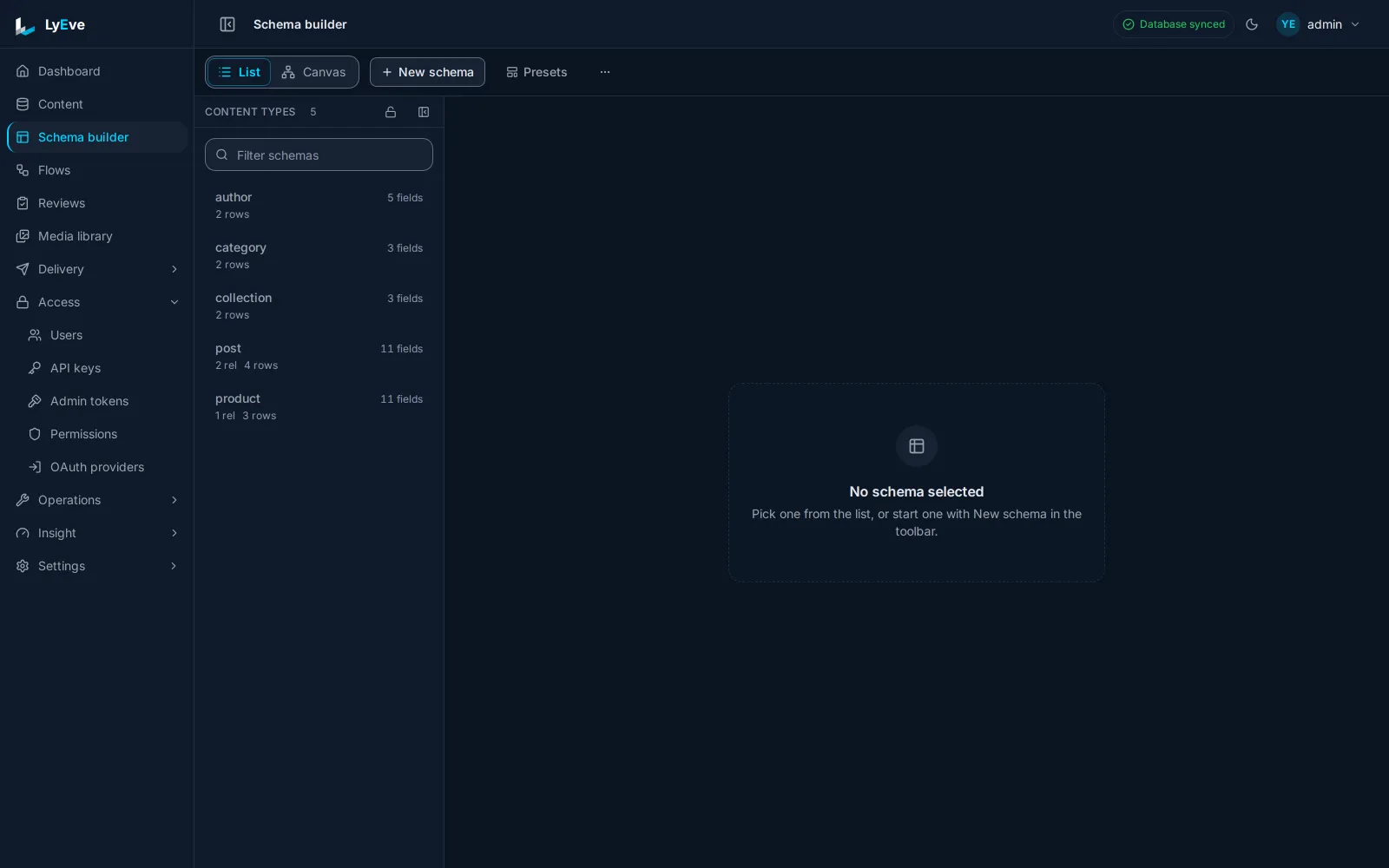 The Schema builder, where each Hygraph model becomes a LyEve content type.
-
Page out the entries. Query each model's plural field with
first: 100, and move on withskipor theaftercursor. Ask forhtmlon each rich text field and keep each entry'sid. Write the entries of one model to an NDJSON file, one per line. -
Import the entries. In the console, open Insight, then Imports, and choose New import. Bulk import is free on every install and reads JSON and NDJSON. Its last step starts with a dry run that reports each row it would reject. A finished import can be rolled back.
-
Bring the files. Query each asset's
url, download the files and upload them to the media library. Then point each media field at its new link. -
Reconnect relations. Every entry gets a new id in LyEve. Set each relation from the Hygraph
idyou kept. -
Rewrite the reads. Each Hygraph query becomes a LyEve GraphQL query or a REST call. A query that selected related entries becomes a second query by id.
Migrate existing content shows each request and its response, and bulk import covers the mapping.
Three questions about Hygraph and LyEve
Can I self-host Hygraph?
Not from what Hygraph publishes. Its pricing page lists shared infrastructure on Hobby and Growth, and shared or dedicated on Enterprise. No page in its sitemap is about self-hosting.
Does LyEve's GraphQL return related entries in one query?
No. A belongs_to relation reads as the related entry's id, and you can filter on it. Fetch the related entry with a second query, or batch the ids into one.
Is GraphQL free in LyEve?
No. GraphQL is the graphql add-on at $3 a month, or included from Pro. The REST Content API is free on every install.
Start LyEve on your database
LyEve runs on PostgreSQL, MySQL 8.0 or 8.4, and SQL Server 2019 or later, Azure SQL included. On SQL Server, turn on read committed snapshot isolation before the engine starts: Installation shows how.
Create a database and a user for LyEve. Then keep only your database's DATABASE_URL line uncommented, fill in its host and password, and start the engine on the free tier:
DATABASE_URL="postgres://lyeve:<password>@db.example.com:5432/lyeve?sslmode=require"
# DATABASE_URL="mysql://lyeve:<password>@tcp(db.example.com:3306)/lyeve?parseTime=true"
# DATABASE_URL="sqlserver://lyeve:<password>@db.example.com:1433?database=lyeve"

docker run -d --name lyeve-engine \
  -e APP_ENV=development \
  -e DATABASE_URL="$DATABASE_URL" \
  -e JWT_SECRET="$(openssl rand -hex 32)" \
  -e ENCRYPTION_KEY="$(openssl rand -hex 32)" \
  -p 3001:3001 -p 3002:3002 \
  ghcr.io/lyeve-labs/lyeve-core:latest
The engine reads which database it talks to from the scheme and creates its tables on first start.
With no database yet, the quickstart starts PostgreSQL and the engine together. The pricing page lists every plan and add-on, from Starter at $4 a month.
Sources
- Hygraph pricing
- Hygraph terms
- Hygraph queries
- Hygraph mutations
- Hygraph pagination
- Hygraph filtering
- Hygraph caching and endpoints
- Hygraph field types
- Hygraph rich text field
- Hygraph remote fields
- Hygraph Management SDK
- Hygraph schema as code
- Hygraph backup and recovery
- Hygraph fetching assets
- DigitalOcean Droplet pricing