Payload lives inside your Next.js app, and LyEve runs beside it as its own service. Both put their core under MIT and both run on PostgreSQL, which makes that shape the first thing to decide.
Payload is not ours. LyEve is, and we wrote this page.
Payload and LyEve, fact by fact
| LyEve | Payload | |
|---|---|---|
| License | MIT engine and console, with commercial parts | MIT, its official plugins included |
| How it runs | Two containers: the Go engine, and LyEve Console on Node | Inside your Next.js app, in its /app folder |
| Content model | Changed in the console or the API, on a running instance | A TypeScript config in your codebase |
| Types for your content | The client packages type every route. No generator for your own content types | payload generate:types writes interfaces from your config |
| Databases | PostgreSQL, MySQL, SQL Server | MongoDB, PostgreSQL, SQLite |
| APIs | REST, free. GraphQL is an add-on at $3 a month, included from Pro | REST, GraphQL and a direct Node.js API, free |
| Several sites in one install | One tenant free, then the Tenant Provisioning add-on at $18 a month, in beta, or Enterprise | An official multi-tenant plugin, MIT and free |
| Free tier | Three admin accounts and one tenant, no cap on content types | Free, with no limit set by the license |
| Price | Free, or plans at $4, $15, $39 and $119 a month | Free. Enterprise by demo, with no published price |
Where Payload is the better choice
- One codebase with your front end. Payload installs in your Next.js app. The CMS and the site share one repository and one deploy. LyEve is a separate service you run beside your app.
- The content model is TypeScript. Collections are code, reviewed in pull requests, and
payload generate:typeswrites interfaces your front end imports. LyEve can keep content types in a YAML file, but it ships no generator for TypeScript types of your own content. - More is free. GraphQL and the multi-tenant plugin cost nothing under MIT. In LyEve, GraphQL is a $3 a month add-on. More than one tenant takes the Tenant Provisioning add-on, $18 a month and in beta, or Enterprise.
- Server code reads content directly. Beside REST and GraphQL, Payload gives your server code a Node.js API that goes straight to the database.
- The community is larger. The Payload repository dates from January 2021 and has more than 45,000 stars on GitHub. LyEve is new.
- It runs on MongoDB and SQLite. Payload's official adapters cover both. LyEve runs on neither.
Where LyEve fits a Next.js team better
- Your front end can be anything. LyEve is a separate service with REST APIs. Its client libraries cover React, Svelte and Vue, and any other language calls the HTTP routes directly. A Next.js site, a Svelte app and a Vue dashboard can read one content service.
- It runs on SQL Server and MySQL. Payload's official database adapters cover neither. The SQL Server and MySQL guides show the setup.
- The content model changes without a deploy. An admin adds or renames a field in the console, and the site keeps serving while it applies. In Payload, the model is part of your app's code, and a change ships with a deploy.
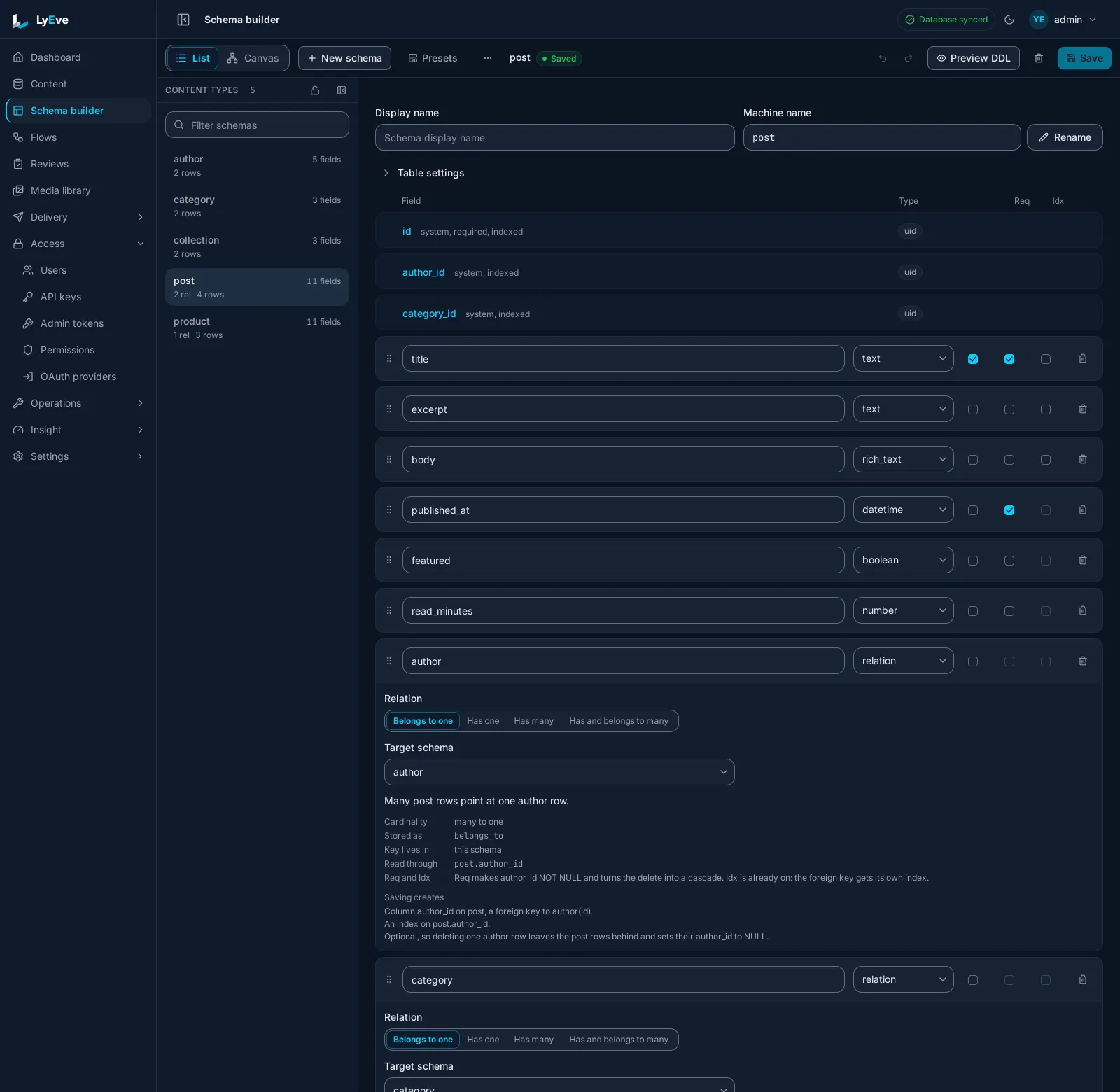 The schema builder's List view, with the fields of the post content type and its relations to author and category.
- The CMS does not tie you to a Next.js version. Your Next.js upgrades follow the version ranges Payload's install guide lists. LyEve's engine does not depend on the framework your front end uses.
- Paid features have published prices. Every LyEve plan and add-on has a price on the pricing page. Payload's Enterprise plan is sold by demo, with no published price.
Payload's MIT and LyEve's mix
Payload is MIT, and so are its official plugins, the multi-tenant and import-export plugins included. Payload is now part of Figma, and its site says Payload remains open source.
LyEve's engine and the console are MIT. These parts are commercial:
- the license verification in the engine image
- the visual flow and schema editors in the admin image
- every plugin, under the Plugin EULA, the free ones included
- any other LyEve code in the images whose source is not public, under the same EULA
A free plugin costs nothing, and it is not open source. 32 of the 52 plugins run with no license key.
The EULA forbids redistributing or modifying a plugin, and using one to provide a hosted service that competes with LyEve Labs without a reseller agreement. What is MIT in LyEve goes through each part and what each license lets you do.
Inside your app or beside it
Payload runs wherever your Next.js app runs, on Node.js. Its site offers starting templates for Vercel and for Cloudflare.
LyEve's engine is one Go container that serves the Admin API and the Content API. The console runs beside it in a second container, a SvelteKit app on Node. The engine needs a PostgreSQL, MySQL or SQL Server database. The deploy guides cover Docker, Docker Compose, Kubernetes, Cloud Run, Fly, Railway and Render.
Which databases each one needs
LyEve runs on PostgreSQL, MySQL or SQL Server. Payload officially supports MongoDB, Postgres and SQLite, and its docs say nearly every feature works on all three. PostgreSQL is the database both run on.
Five client sites, priced
Take a Next.js team that runs five client sites from one CMS, self-hosted.
Payload. One Next.js app with the multi-tenant plugin costs $0 in licenses. Its Enterprise plan is priced on request.
LyEve. Plans are $4, $15, $39 and $119 a month, and add-ons cost from $2 to $18 a month. Here the team runs one install with five tenants. A free install runs one tenant. More than one tenant takes the Tenant Provisioning add-on or Enterprise, which includes it:
- The add-on is $18 a month and in beta, with no limit on the number of tenants. With GraphQL beside it, the cart holds two add-ons, $18 + $3 = $21 a month. The volume discount does not apply, because it starts at three add-ons.
- Enterprise is $119 a month, or $1,190 a year paid annually, and it includes GraphQL.
- Any license removes the free tier's limit of three admin accounts, for a larger team in the console.
On license cost, Payload wins this case clearly. LyEve's free path is five separate free installs, one per client, which cost nothing and keep each client on its own install. The post on serving many clients shows what each client sees on the add-on and on Enterprise, and what its admin may do.
For one site, both cost nothing to self-host.
Moving from Payload to LyEve
A move has two parts: the content types, then the entries. The tools for both are free on every install.
- Rebuild the content types. LyEve's schema import converts definitions from JSON Schema, OpenAPI, Strapi, Contentful and WordPress. It has no converter for a Payload config. Recreate each collection in the schema builder, or write the content types as a YAML file and import it with a dry run. See content type portability.
- Export the entries. Add Payload's import-export plugin to your config, and it downloads a collection as CSV or JSON from the admin panel. Its JSON file is an array of documents, which is what LyEve's bulk import reads.
- Import them. In the console, open Insight, then Imports, and choose New import. Map the columns, run the dry run, then import. A finished import can be rolled back.
- Rebuild what lives in code. Hooks, access control functions and custom components do not convert, because they are code in your Payload config. Rebuild access with LyEve's access rules and automation with flows. Media files move separately, through the media library.
The migration guide shows the same steps over the API.
What Next.js teams ask about LyEve
Can I use LyEve with Next.js?
Yes. LyEve runs as its own service, and a Next.js app reads content from the Content API with the base client or the React client. See the client packages.
Does LyEve run on MongoDB?
No. LyEve needs PostgreSQL, MySQL or SQL Server.
Is LyEve MIT, like Payload?
The engine and the console are MIT, and the license section lists the commercial parts. A free plugin costs nothing, and it is not open source.
Does LyEve generate TypeScript types for my content?
No. The client packages type every route, but LyEve ships no generator for your own content types.
Which client libraries need a license?
Three of the eight. The GraphQL, gRPC and realtime clients call features that are add-ons, and all three are included from the Pro plan at $15 a month. GraphQL alone is $3 a month and realtime $8. The base client and the REST, React, Svelte and Vue clients work on the free tier.
Start LyEve on your database
LyEve runs on PostgreSQL, MySQL 8.0 or 8.4, and SQL Server 2019 or later, Azure SQL included. On SQL Server, turn on read committed snapshot isolation before the engine starts: Installation shows how.
Create a database and a user for LyEve. Then keep only your database's DATABASE_URL line uncommented, fill in its host and password, and start the engine on the free tier:
DATABASE_URL="postgres://lyeve:<password>@db.example.com:5432/lyeve?sslmode=require"
# DATABASE_URL="mysql://lyeve:<password>@tcp(db.example.com:3306)/lyeve?parseTime=true"
# DATABASE_URL="sqlserver://lyeve:<password>@db.example.com:1433?database=lyeve"

docker run -d --name lyeve-engine \
  -e APP_ENV=development \
  -e DATABASE_URL="$DATABASE_URL" \
  -e JWT_SECRET="$(openssl rand -hex 32)" \
  -e ENCRYPTION_KEY="$(openssl rand -hex 32)" \
  -p 3001:3001 -p 3002:3002 \
  ghcr.io/lyeve-labs/lyeve-core:latest
The engine reads which database it talks to from the scheme and creates its tables on first start.
With no database yet, the quickstart starts PostgreSQL and the engine together. The pricing page lists every plan and add-on, from Starter at $4 a month.