Features
Caching
Included free on every install, with one cache provider of any kind and up to 10 response cache rules per tenant. Several providers with failover, moving entries between providers, the provider benchmark and more rules need a license with the
cache-profeature. See pricing.
Caching keeps the answers to frequent reads, such as content items, content lists and the content type list, so repeated requests skip the database. A response cache rule adds the answers of a public route, such as media files. A content change clears the affected entries, so readers do not see stale content after a write.
How it works
Link to the section How it works| Setup | Where entries live | Use it when |
|---|---|---|
| Default | Each replica's memory. | You run one replica. |
CACHE_DRIVER=redis | One Redis, Valkey or KeyDB. | You run more than one replica. |
| Listed providers | Several servers, tried in order. More than one needs cache-pro. | One cache server going down must not slow every read. |
A content write clears the cached reads it changes, in its own tenant. Flushing the cache never signs anyone out, because sessions are kept apart from it.
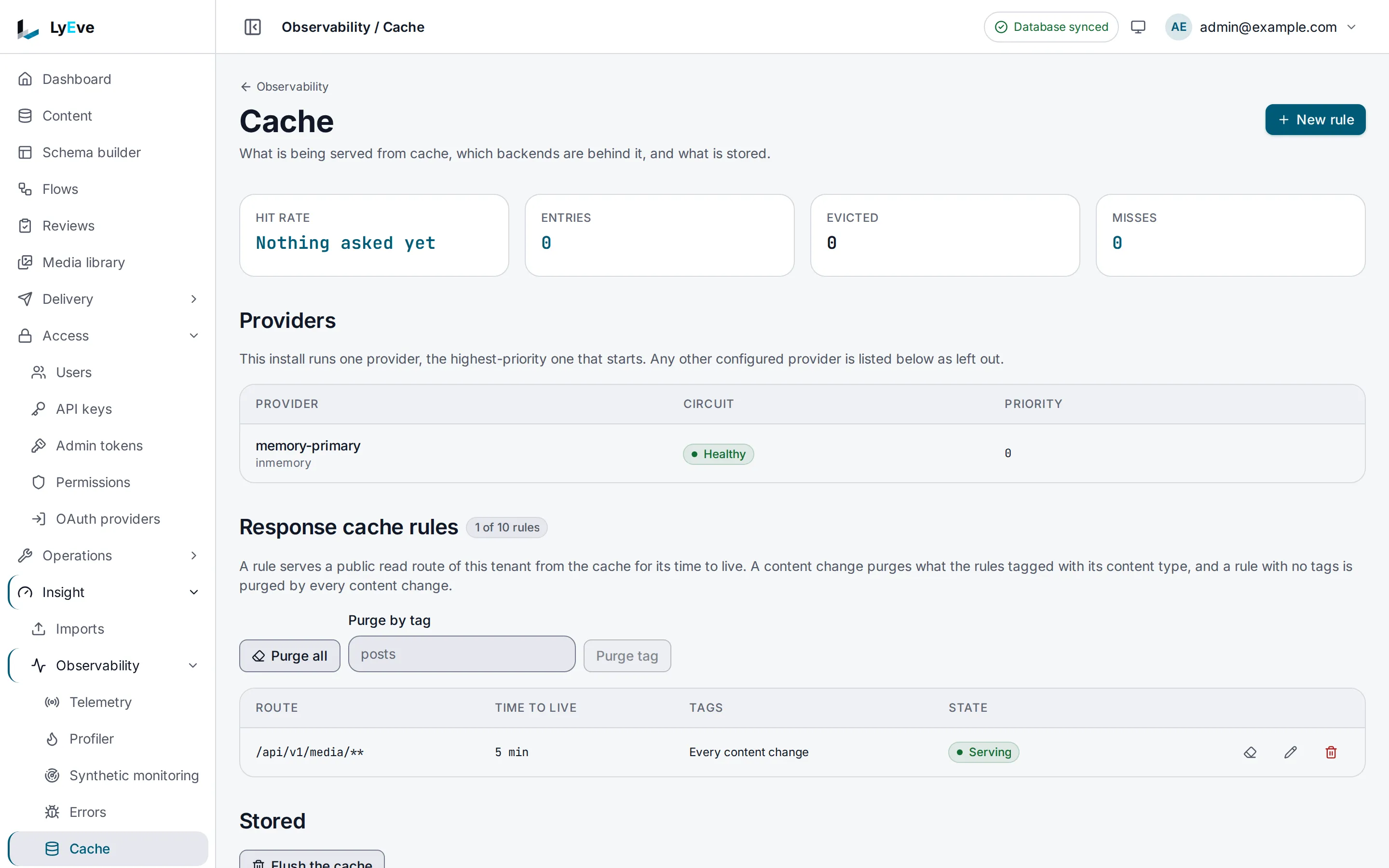
In LyEve Console, caching is under Insight > Observability > Cache. The top row gives the Hit rate, Entries, Evicted and Misses. Entries counts what the provider serving reads holds. Providers lists each cache provider with the state of its circuit and its Priority. Response cache rules lists each rule's Route, Time to live, Tags and state, with Purge all, and Purge by tag with its Purge tag button, above them. Stored, at the bottom, has Flush the cache for a super admin and lists the stored entries a page at a time, with their Key, Size, Tags and Expires. A tenant admin sees Flush this tenant's responses there instead, which flushes only that tenant's cached responses after a confirmation, and no entry list, because the store holds every tenant's keys.
For the console steps, you are signed in to the console as a super admin. For the API
steps, you need a super admin token in TOKEN. The
quickstart shows how to get one.
1. List the cache providers and their state.
Console v0.28.0
Open Insight > Observability > Cache. Providers lists memory-primary, of kind
inmemory, as Healthy with Priority 0.
Engine API v0.62.0
curl http://localhost:3001/api/admin/cache/providers \ -H "Authorization: Bearer $TOKEN"{ "data": [ { "name": "memory-primary", "kind": "inmemory", "priority": 0, "hits": 0, "misses": 0, "entries": 0, "max_size": 10000, "circuit_state": "closed", "connected": true, "active": true } ], "inactive": [], "licensed": false, "limit": 50, "offset": 0, "total_count": 1}priority is the provider's place in the failover order, 0 first.
2. Read the cache counters.
Console v0.28.0
The top row of the same page gives the Hit rate, Entries, Evicted and Misses. A fresh install reads No requests yet under Hit rate.
Engine API v0.62.0
curl http://localhost:3001/api/admin/cache/stats \ -H "Authorization: Bearer $TOKEN"The answer carries hits, misses, sets, deletes, flushes and evictions, summed over
the providers, and the entries and max_size of the provider serving reads.
3. Cache the answers of a public route for five minutes. A published file in the
media library is a public route that answers without a token on every install.
Step 3 there publishes one, and its public path has the form /api/v1/media/<id>/<name>.
Console v0.28.0
- Choose New rule.
- Enter
/api/v1/media/**in Route and300in Time to live, in seconds. Leave Tags empty, and keep Serve from the cache on. - Choose Create.
Response cache rules lists the route with 5 min, Every content change under Tags, and Serving.
Engine API v0.62.0
curl -X POST http://localhost:3001/api/admin/cache/rules \ -H "Authorization: Bearer $TOKEN" \ -H "Content-Type: application/json" \ -d '{"pattern": "/api/v1/media/**", "ttl_seconds": 300}'The answer is 201 with the rule, and "tags": [].
Load the file twice with no token, at its public path. Media library shows the path
under Public path, and the API answer gives it as public_url. Put your file's id and name
in place of <id> and hero.png:
curl -s -o /dev/null -D - http://localhost:3002/api/v1/media/<id>/hero.pngThe first answer carries X-Cache: MISS and the second X-Cache: HIT, until the rule's five
minutes pass or a content change clears it. A HEAD request carries no X-Cache header.
4. Flush the cache.
Console v0.28.0
Under Stored, choose Flush the cache, then Flush in the dialog that asks. The page confirms Cache flushed., and Stored reads Nothing is cached.
Engine API v0.62.0
curl -X POST http://localhost:3001/api/admin/cache/flush \ -H "Authorization: Bearer $TOKEN"{ "message": "cache flushed" }The next anonymous load of the file answers X-Cache: MISS again.
One provider, or several with cache-pro
Link to the section One provider, or several with cache-proEvery install runs one cache provider of any kind: in-memory, Redis, Valkey or
KeyDB, with every caching feature on it. With several providers listed and no
cache-pro, the instance starts the first one that works, logs each one it
left out by name, and lists them on GET /api/admin/cache/providers under
inactive with the reason provider_limit. The answer also carries
licensed.
A license with cache-pro starts the rest without a restart. If it lapses,
every running provider keeps running until the next restart, which starts the
first one only. The cache that holds sign-in tokens is separate and never
counts as a provider.
Share the cache through Redis
Link to the section Share the cache through RedisCACHE_DRIVER=redisREDIS_URL=redis://redis.internal:6379/0If CACHE_DRIVER=redis is set without REDIS_URL, the instance connects to
redis://localhost:6379/0. The same Redis also shares sessions and sign-in
lockouts between replicas. See scale and tune.
Fail over between cache servers
Link to the section Fail over between cache serversThis needs cache-pro. List providers by number, starting at 0. The lowest number is tried first.
When a provider stops answering, requests move to the next one, and the
provider returns to service once it answers again.
CACHE_PROVIDER_0_KIND=redisCACHE_PROVIDER_0_NAME=primaryCACHE_PROVIDER_0_URL=redis://redis-a.internal:6379/0CACHE_PROVIDER_0_ENABLED=trueCACHE_PROVIDER_1_KIND=inmemoryCACHE_PROVIDER_1_NAME=localCACHE_PROVIDER_1_ENABLED=true| Variable | Meaning |
|---|---|
CACHE_PROVIDER_N_KIND | redis, valkey, keydb or inmemory. The list ends at the first number with no kind. |
CACHE_PROVIDER_N_NAME | A name for the console and the API. Defaults to <kind>-<N>. |
CACHE_PROVIDER_N_URL | The server address. |
CACHE_PROVIDER_N_ENABLED | Must be true, or the provider is skipped. |
CACHE_PROVIDER_N_DEFAULT_TTL | Entry lifetime for this provider, such as 5m. |
CACHE_PROVIDER_N_MAX_ENTRIES | Entry ceiling for an inmemory provider. |
When CACHE_PROVIDER_0_KIND is set, CACHE_DRIVER and REDIS_URL are not
used for the cache. A provider that was skipped can be put back at once with
POST /api/admin/cache/providers/{name}/reset-circuit.
Skip a failing server faster
Link to the section Skip a failing server faster| Variable | What it does | Default |
|---|---|---|
CACHE_CIRCUIT_ENABLED, or CACHE_PROVIDER_N_CIRCUIT_ENABLED | Skip a provider after repeated failures. | false |
CACHE_CIRCUIT_MAX_FAILURES | Failures in a row before it is skipped. | 5 |
CACHE_CIRCUIT_FAILURE_WINDOW | The window those failures are counted in. | 120s |
CACHE_CIRCUIT_OPEN_TIMEOUT | How long it is skipped before a retry. | 30s |
CACHE_CIRCUIT_HALF_OPEN_SUCCESSES | Successful retries before it is used again. | 2 |
The CACHE_CIRCUIT_* names apply to CACHE_DRIVER=redis. With listed
providers, use the same names with the CACHE_PROVIDER_N_ prefix, such as
CACHE_PROVIDER_0_CIRCUIT_MAX_FAILURES.
Move to a new cache server
Link to the section Move to a new cache serverCopy entries from one provider to another before you switch. This needs a
super admin and cache-pro. Console v0.25.0 has no screen to move entries or
to time the providers, so both run over the API:
curl -X POST http://localhost:3001/api/admin/cache/migrate \ -H "Authorization: Bearer $TOKEN" \ -H "Content-Type: application/json" \ -d '{"source": "primary", "destination": "replacement", "pattern": "*", "dry_run": true}'{"source": "primary", "destination": "replacement", "total_keys": 1, "migrated_keys": 0, "failed_keys": 0, "skipped_keys": 0, "duration": 275379}pattern is a key glob and defaults to *. dry_run counts the keys and
copies none. Without overwrite, a key the destination already holds is
counted in skipped_keys and left as it is, and with "overwrite": true it is
replaced and counted in migrated_keys. duration is in nanoseconds.
GET /api/admin/cache/benchmark?n=5 times each provider, also with
cache-pro. Its answer carries providers_benchmarked and, per provider in
results, the read and write rates and latencies. n above 100 answers
400. Both answer 400 for a malformed request and 404 for an
unknown provider before the license is read, so a 402 means only that the
request needs cache-pro.
Cache the answers of public routes
Link to the section Cache the answers of public routesA response cache rule names a public read route and keeps its answers in the
cache. Each tenant holds 10 rules on every install, and cache-pro lifts the
limit. There is no limit on how long an answer may be kept.
| Field | Meaning |
|---|---|
pattern | A path under /api/v1/, at most 255 characters. A segment is literal, a glob within the segment such as post-*, a parameter such as {schema} that matches any one segment, or a final ** that matches whatever follows. One rule per pattern per tenant. |
ttl_seconds | How long an answer is kept. Any positive number of seconds. |
tags | Up to 32 content type names whose changes clear what the rule cached. A rule with no tags is cleared by every content change in its tenant. |
enabled | A rule that is off caches nothing and keeps its place. Default true. |
Rules serve anonymous public reads and nothing else: a GET under /api/v1/
that carries no credential and that the instance resolved to a tenant. A
request with an Authorization header, an API key or a cookie is never served
from the cache and never stored, because a signed-in caller may be shown a
different answer. The Content API's own content reads need a credential, so in
practice rules serve the public routes that answer without one, such as
search, localization and media files.
- On a single-tenant install every anonymous read belongs to that tenant, so any public route a rule names can be served.
- On a multi-tenant install an anonymous request reaches a tenant only through a domain mapped to it. The tenant's public reads are served from the cache when they arrive on its own domain, and the same read on the shared hostname passes through.
The cache does not warm itself, and no route fills it ahead of traffic. After a clear, the next anonymous read of a path fills it again.
A search answered from the cache is not counted in the search analytics. An external search engine takes a change a few seconds after the write, so the cached searches of that content type are cleared again once the engine has it, and an answer read in between does not stand for the rule's whole lifetime.
The first enabled rule, oldest first, whose pattern matches decides. The cache
key is the tenant, the path, the query, Accept-Language and Accept. An
answer is stored only when it is a 200 that sets no cookie, is not marked
no-store or private, and is at most 1 MiB. A hit answers with
X-Cache: HIT, and a matching If-None-Match gets 304.
Cache public delivery
Link to the section Cache public deliveryThe public delivery routes answer without a credential, so a rule can keep their answers. One rule covers every marked content type:
curl -X POST http://localhost:3001/api/admin/cache/rules \ -H "Authorization: Bearer $TOKEN" \ -H "Content-Type: application/json" \ -d '{"pattern": "/api/v1/delivery/**", "ttl_seconds": 300, "tags": []}'With no tags, every content change in the tenant clears the rule's answers, and so does a change to a content type's definition. That keeps an entry that populates a changed one fresh too. A rule tagged with content type names is cleared by changes to those types, and by a change to their definitions, only. The rule keeps answers on the instance, and a CDN in front still needs its own purge.
What is never cached
Link to the section What is never cachedWhatever a rule names, these requests are never served from the cache or stored in it, and a pattern that can name only them is refused when you save it:
- Sign-in, sessions and second factors:
/api/v1/followed byauth,oauth,sso,saml,mfa,passkey,passkeys,webauthn,magic-link,password-reset,session,sessions,me,csrforcaptcha. - Signed and expiring links: local storage downloads under
/api/v1/storage/local/, and any request whose query carriessig,exp,expiryortoken, or a name containingsignature,expires,tokenorcredential. - Flow endpoints and incoming webhooks:
/api/v1/flows/and/api/v1/webhooks/. - Experiments and answers about the caller:
/api/v1/ab/, the A/B test, feed and behavior routes of recommendations,/api/v1/regions/nearest,/api/v1/quotas/,/api/v1/quota-requests,/api/v1/gdpr/and/api/v1/scim/. - Streams:
/api/v1/realtime/and/api/v1/ws/.
Clear cached answers
Link to the section Clear cached answers- A content create, update or delete clears, in its tenant, the answers of
every rule tagged with that content type and of every rule with no tags.
Publishing or unpublishing an entry through
PUT /api/v1/content/{schema}/{id}/publishor.../unpublishis an update and clears the same answers. - Changing or deleting a rule clears what it cached.
- A person's erasure clears,
in every tenant, the answers of every rule tagged
commentsorform_submissionsand of every rule with no tags. POST /api/admin/cache/rules/{id}/purgeclears one rule's answers.POST /api/admin/cache/rules/purgewith{"tag": "posts"}clears every rule carrying the tag, and with no tag every answer the tenant has cached.
Each replica reads the rules again at most every 10 seconds. With the in-memory provider each replica keeps its own cached answers, so a clear reaches only the replica that saw the change. A shared Redis gives every replica one cache.
Rate limits, the firewall and quotas count a cache hit like any other request.
GET /api/admin/cache/rules answers the rules with licensed and limits,
as {"rules": {"limit": 10, "current": 3}}, where limit is null with
cache-pro. If the license lapses, every rule keeps serving, and only a new
rule past 10 is refused.
Settings
Link to the section Settings| Variable | What it does | Default |
|---|---|---|
CACHE_DRIVER | memory or redis, when no providers are listed. | memory |
REDIS_URL | The Redis address for CACHE_DRIVER=redis. | redis://localhost:6379/0 |
CACHE_TTL | How long an entry is kept when it was stored without a lifetime of its own, and how long each replica keeps a content item or list in its memory. | 60s |
CACHE_MAX_ENTRIES | Entry ceiling for the in-memory backend. It also caps each replica's content item and content list caches, which hold 1000 each when it is unset. | 10000 |
CACHE_PROBE_INTERVAL | How often providers are checked, such as 10s. | 15s |
Caching runs on every install. If you set LYEVE_PLUGINS to choose which
features start, include cache in it. See
licensing and tiers.
Cache routes
| Method | Path | Who | Result |
|---|---|---|---|
GET | /api/admin/cache/stats | Super admin | hits, misses, sets, deletes, flushes and evictions summed over the providers, with the entries and max_size of the provider serving reads. |
GET | /api/admin/cache/entries | Super admin | A page of the current entries, ordered by key, as data, total_count, limit and offset. Each entry has key, size, created_at, expires_at, ttl_mode and tags. Only the in-memory provider can list its entries. Behind any other provider the page is empty and carries a note. |
GET | /api/admin/cache/tags/{tag} | Super admin | Keys carrying a tag. |
POST | /api/admin/cache/flush | Admin | Clears your tenant's cached responses, or the whole cache on a single-tenant install. |
POST | /api/admin/cache/flush/{tag} | Admin | Clears every entry with a tag. |
DELETE | /api/admin/cache/entries/{key} | Admin | Clears one entry. |
GET | /api/admin/cache/providers | Admin | Providers with their state and priority, with limit and offset, plus licensed and the inactive providers. |
GET | /api/admin/cache/providers/{name} | Admin | One provider, with its priority. |
POST | /api/admin/cache/providers/{name}/reset-circuit | Super admin | Puts a skipped provider back in service now. |
POST | /api/admin/cache/migrate | Super admin | Copies entries from one provider to another. Needs cache-pro. |
GET | /api/admin/cache/benchmark | Super admin | Times each provider. Query: provider, n (at most 100). Needs cache-pro. |
GET | /api/admin/cache/rules | Admin | Your tenant's response cache rules, with licensed and limits. |
POST | /api/admin/cache/rules | Admin | Create a rule: pattern, ttl_seconds, tags, enabled. 201. |
GET | /api/admin/cache/rules/{id} | Admin | One rule. |
PUT | /api/admin/cache/rules/{id} | Admin | Replace a rule and clear what it cached. |
DELETE | /api/admin/cache/rules/{id} | Admin | Delete a rule and clear what it cached. |
POST | /api/admin/cache/rules/{id}/purge | Admin | Clear one rule's cached answers. |
POST | /api/admin/cache/rules/purge | Admin | Clear the answers of every rule with tag, or all of your tenant's. |
| Status | Message |
|---|---|
400 | tag is required, key is required, provider name is required |
400 | source and destination are required |
400 | ?n= must be a positive integer, ?n= must not exceed 100 |
402 | payment_required, naming feature:cache-pro, on migrate or the benchmark |
402 | cap_exceeded with "cap": "cache.rules", an 11th rule without cache-pro |
403 | cannot query another tenant's tags, or a key that belongs to another tenant. |
404 | provider "<name>" not found |
409 | the tenant already has a rule for this pattern |
422 | pattern must be a path under /api/v1/, pattern names routes the cache never serves: sign-in, signed downloads, flows, experiments or answers about the caller, ttl_seconds must be a positive number of seconds, a rule carries at most 32 tags, each tag is 1 to 64 letters, digits, dots, dashes or underscores |
429 | a benchmark is already in progress: try again later |
Related
Link to the section Related- Scale and tune: everything more than one replica shares, Redis included.
- Flows: a response cache for one custom endpoint.
- Idempotent requests: safe retries, also shared through Redis.