Features
OAuth sign-in
Included free on every install, with one sign-in provider per install, added by hand or from the Google, GitHub and Apple templates. More providers, the Okta and Azure AD templates, role mapping and a backup provider need a license with the
oauth-profeature. See pricing.
OAuth sign-in puts a Sign in with button on LyEve Console's login page for each identity provider you configure. Your team signs in with the account they already use at work, and LyEve creates their console account the first time they arrive.
In the console
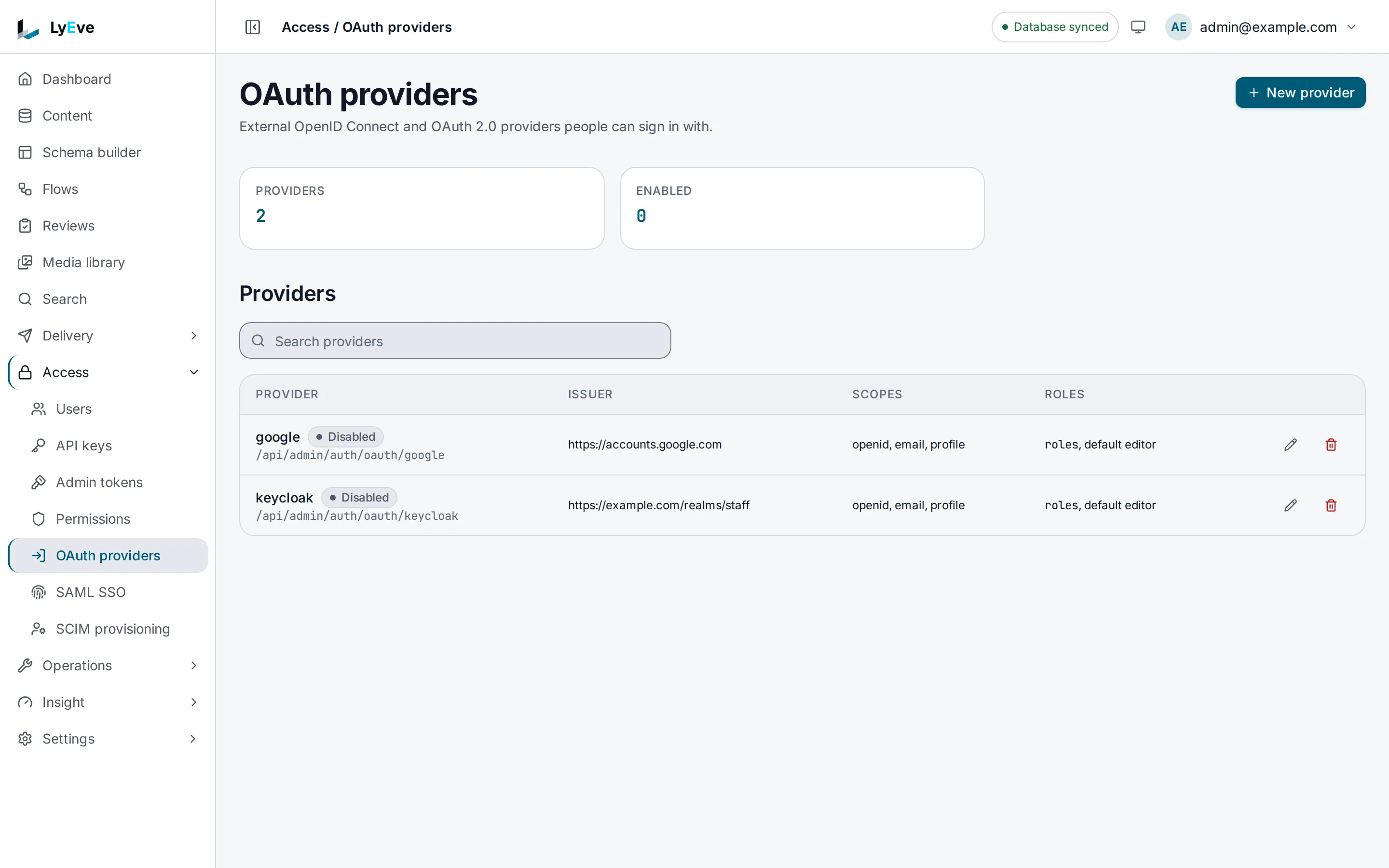
Link to the section In the consoleOpen Access > OAuth providers. Only a super admin sees it. The list shows each provider with its issuer, scopes and roles, and whether it is enabled.
- Choose New provider.
- Fill in Provider name, Issuer URL, Client ID and Client secret. Scopes, Roles claim and Default roles are optional.
- Enabled is off when the form opens. Turn it on to offer the provider on the login page, then choose Create.
The pencil on a row edits a provider. Leave New client secret blank to keep the stored one. Templates and the backup provider are set over the API below.
How it works
Link to the section How it works| Step | What happens |
|---|---|
| Start | The browser opens /api/admin/auth/oauth/{provider}, and LyEve redirects it to the provider. |
| Sign in | The person signs in at the provider. |
| Callback | The provider sends the browser to /api/admin/auth/oauth/{provider}/callback. LyEve checks the answer and creates the account on a first visit. |
| Session | LyEve sets the session cookie and redirects to /admin. |
What you can rely on:
- The sign-in uses the authorization code flow with PKCE, a CSRF
stateand an OIDCnonce. The ID token's signature, issuer, audience and expiry are checked before anyone is signed in. - A provider must report the email as verified. An unverified email is refused.
- A provider can never grant
adminorsuper_admin. Those roles are dropped from whatever the provider sends. - An existing user keeps the roles stored in LyEve. A provider's roles apply only when the sign-in creates the user.
- An account OAuth creates belongs to the tenant it signed up in. See accounts a tenant's provider creates. Its password, reset and magic link sign-ins stay open for the tenant's sign-in window after each sign-in through the provider.
- Client secrets are encrypted at rest and never returned by any route.
- A session from OAuth sign-in lasts
JWT_EXPIRY_SECSand comes with no refresh token, so the person signs in again when it ends.
Turn it on
Link to the section Turn it on- Check what your tier allows in free and oauth-pro.
- Set
LYEVE_BASE_URLto the public address of the instance, such ashttps://lyeve.example.com. Every callback address is built from it, never from the request'sHostheader. - Set
SECURE_COOKIE=truewhen the instance is served over HTTPS. - Restart the instance, then add a provider in the console or with the API below.
This adds Google as the install's provider. Create an OAuth client in the
Google Cloud console first, and register
<LYEVE_BASE_URL>/api/admin/auth/oauth/google/callback as its redirect
address. Sign in as a super admin.
Console v0.28.0
- Open Access > OAuth providers and choose New provider.
- Enter
googlein Provider name,https://accounts.google.comin Issuer URL, and your client's Client ID and Client secret. Leave Scopes, Roles claim and Default roles empty, which savesopenid email profile,rolesandeditor. - Turn Enabled on and choose Create. The row shows the provider as enabled.
Engine API v0.62.0
You need a super admin token in TOKEN. The
quickstart shows how to get one.
-
List the templates:
Shell curl http://localhost:3001/api/admin/oauth-templates \-H "Authorization: Bearer $TOKEN"The answer lists five templates (
google,github,okta,azureadandapple), each with thefieldsit needs. -
Read the Google template and the callback address to register:
Shell curl http://localhost:3001/api/admin/oauth-templates/google \-H "Authorization: Bearer $TOKEN"The answer holds the
templateand aredirect_urisuch ashttps://lyeve.example.com/api/admin/auth/oauth/google/callback. WithoutLYEVE_BASE_URLthe answer is409:JSON {"code":"oauth.base_url_required","error":"OAuth is not configured: set base_url in configuration"} -
Apply the template with your client's values:
Shell curl -X POST http://localhost:3001/api/admin/oauth-templates/apply \-H "Authorization: Bearer $TOKEN" \-H "Content-Type: application/json" \-d '{"key": "google", "overrides": {"client_id": "1234.apps.googleusercontent.com", "client_secret": "GOCSPX-...", "enabled": true}}'JSON {"provider": {"id": "1f04498a-c8d8-48f0-8165-8001a04a20b3","name": "google","client_id": "1234.apps.googleusercontent.com","issuer_url": "https://accounts.google.com","scopes": ["openid", "email", "profile"],"roles_claim": "roles","default_roles": ["editor"],"enabled": true,"hosted_domain": "","kind": "oidc","org": "","created_at": "2026-10-01T09:30:00Z","updated_at": "2026-10-01T09:30:00Z"},"redirect_uri": "https://lyeve.example.com/api/admin/auth/oauth/google/callback","template": "google"}The answer is
201. A provider made from a template is disabled unlessoverridesholds"enabled": true.
Check what the login page will offer. The route is public:
curl http://localhost:3001/api/admin/auth/oauth-providers[{ "name": "google" }]Open the console's login page. Under or continue with it shows Sign in with google, which sends the browser to Google.
Free and oauth-pro
Link to the section Free and oauth-pro| Free | With oauth-pro | |
|---|---|---|
| Providers | 1 per install, enabled or not | Unlimited |
| Templates | google, github and apple, or any OpenID Connect issuer by hand | Also okta and azuread |
| Roles | The roles claim and the editor default role | Any roles_claim and any default_roles |
| Failover | Health checks and the circuit reset | Also a backup_provider_id |
Providers belong to the instance, because the callback address is the
instance's, so every tenant shares the one free provider. Updating, disabling
and deleting a provider, the health view and every account link route are free.
The license is read on every request. A provider set up with oauth-pro keeps
signing people in with what it stored after a license lapses, and only a new
provider or a change to a paid option is refused. A second provider on a free
install answers:
{"error": "cap_exceeded", "cap": "oauth.providers", "limit": 1, "current": 1, "upgrade_url": "https://app.lyeve.com/pricing?skus=plugin-oauth-pro&utm_campaign=oauth.providers&utm_medium=product&utm_source=admin"}A paid template or option answers 402 with
{"error": "payment_required", "plugin": "oauth", "feature": "feature:oauth-pro", "upgrade_url": ""}.
Choose a template
Link to the section Choose a template| Template | Fields in overrides |
|---|---|
google | client_id, client_secret |
github | client_id, optional client_secret |
okta | domain, client_id, client_secret, optional authorization_server. Needs oauth-pro. |
azuread | tenant_id (a directory id, common or consumers), client_id, client_secret. Needs oauth-pro. |
apple | client_id (the Service ID), client_secret, team_id, key_id |
Every template also takes name, to save the provider under another name, and
enabled. With name set, register the redirect_uri from the apply answer,
because the callback path uses the name.
Add any OpenID Connect provider
Link to the section Add any OpenID Connect providerRegister {LYEVE_BASE_URL}/api/admin/auth/oauth/{name}/callback as the
redirect address with the provider, using the name you give it here.
Console v0.28.0
On Access > OAuth providers, choose New provider. Enter keycloak in
Provider name, the realm's address in Issuer URL, such as
https://sso.example.com/realms/staff, and the client's Client ID and
Client secret. Leave Enabled on and choose Create.
Engine API v0.62.0
curl -X POST http://localhost:3001/api/admin/oauth-providers \ -H "Authorization: Bearer $TOKEN" \ -H "Content-Type: application/json" \ -d '{ "name": "keycloak", "client_id": "lyeve-admin", "client_secret": "s3cr3t", "issuer_url": "https://sso.example.com/realms/staff", "roles_claim": "roles", "default_roles": ["editor"], "enabled": true }'The answer is 201 with the saved provider. Leave out enabled and the
provider is saved turned off.
An issuer address that is private, internal or does not resolve is refused.
Provider fields
| Field | Meaning | Default |
|---|---|---|
name | The provider's name in the sign-in URL. Lowercased, spaces become _ | required |
client_id, client_secret | The client registered with the provider | client_id required |
issuer_url | The provider's OIDC issuer. An address that is private, internal or does not resolve is refused | required |
scopes | Scopes to request | ["openid", "email", "profile"] |
roles_claim | The ID token claim that carries roles. Another claim needs oauth-pro | roles |
default_roles | Roles a new user gets when the provider sends none. Other roles need oauth-pro | ["editor"] |
enabled | Whether the login page offers it | false |
backup_provider_id | Another provider to send sign-ins to while this one is failing. Needs oauth-pro | none |
A PUT changes only the fields you send, so the stored secret stays unless
you send a new one.
When an email already has an account
Link to the section When an email already has an accountWhen a provider identity signs in for the first time and a user with the same
email already exists in the tenant, the sign-in is refused with 409. An
address that only another tenant holds is not a conflict: the sign-in creates
an account of this tenant's own. LyEve never links an
existing account on its own, because someone holding that email at another
provider could otherwise take the account over. Sign in through a provider
before creating a password account for the same person, or remove the
password account first.
A link ties one LyEve user to one identity at one provider. Links belong to a
tenant, and a user can hold several. A super admin reads them under
/api/admin/account-links and can unlink one, make one primary, or move an
identity to another user.
Manage account links
Unlinking takes a CSRF token. Read the link first, which sets a csrf_token
cookie, then send the same value back as the cookie and the X-CSRF-Token
header:
curl -c jar -H "Authorization: Bearer $TOKEN" \ http://localhost:3001/api/admin/account-links/$LINK_IDcurl -b jar -X DELETE -H "Authorization: Bearer $TOKEN" \ -H "X-CSRF-Token: $(awk '/csrf_token/ {print $7}' jar)" \ http://localhost:3001/api/admin/account-links/$LINK_ID{ "message": "unlinked" }A user's last link cannot be removed: that answers 409.
PATCH /api/admin/account-links/{id}/primary with {"user_id": "<user id>"}
makes a link primary and answers {"message": "primary set"}. A link made at
sign-in is not primary until you do this.
POST /api/admin/account-links/resolve moves an identity to another user:
{ "provider_name": "google", "provider_sub": "109876543210", "target_user_id": "5f0c7b1e-1d2a-4c3b-9e8f-0a1b2c3d4e5f", "source_user_id": "8a9b0c1d-2e3f-4a5b-8c7d-6e5f4a3b2c1d"}The answer is {"message": "conflict resolved"}.
Keep sign-in up when a provider fails
Link to the section Keep sign-in up when a provider failsEach enabled provider's discovery address is checked every 30 seconds.
GET /api/admin/oauth-providers/health returns a providers list, one entry per provider, with
healthy, latency_ms, last_checked_at, last_error and a circuit whose
state is closed, open or half_open.
After 5 failures within 60 seconds a provider's state turns open. While it
is open, a sign-in through it goes to its backup_provider_id (set with
oauth-pro) when that
provider is enabled, and to the provider itself when there is no backup. After
30 seconds the next sign-in tries the provider again, and a success closes the
circuit. POST /api/admin/oauth-providers/{id}/circuit/reset sets it back to
closed at once.
Settings
Link to the section Settings| Variable | What it does | Default |
|---|---|---|
LYEVE_BASE_URL | Public address the callback is built from. Required. | unset |
SECURE_COOKIE | Marks the sign-in and session cookies Secure. Set true behind HTTPS. | false |
JWT_EXPIRY_SECS | Lifetime of the session a sign-in creates. | 900 |
OAUTH_HEALTH_CHECK_TIMEOUT | Whole seconds the health check waits for a provider. | 5 |
If you set LYEVE_PLUGINS, include oauth in it.
Every route that needs a role takes a signed-in session. An admin token is
refused on them with 403.
Sign-in, providers, templates and links
| Method | Path | Role | Purpose |
|---|---|---|---|
GET | /api/admin/auth/oauth-providers | public | Names of enabled providers, for login buttons |
GET | /api/admin/auth/oauth/{provider} | public | Start sign-in. Redirects the browser to the provider |
GET | /api/admin/auth/oauth/{provider}/callback | public | Where the provider sends the browser back |
GET | /api/admin/oauth-providers | admin | List providers, paginated |
POST | /api/admin/oauth-providers | super_admin | Add a provider. 201 |
PUT | /api/admin/oauth-providers/{id} | super_admin | Change a provider |
DELETE | /api/admin/oauth-providers/{id} | super_admin | Remove a provider. 200 with {"message": "deleted"} |
GET | /api/admin/oauth-providers/health | admin | Whether each provider is reachable |
POST | /api/admin/oauth-providers/{id}/circuit/reset | super_admin | Mark a failing provider usable again |
GET | /api/admin/oauth-templates | admin | List the templates |
GET | /api/admin/oauth-templates/{key} | admin | Read one template and its callback address |
POST | /api/admin/oauth-templates/apply | super_admin | Add a provider from a template. 201 |
GET | /api/admin/account-links?user_id={id} | admin | The provider identities linked to a user |
GET | /api/admin/account-links/{id} | admin | Read one link |
DELETE | /api/admin/account-links/{id} | super_admin | Unlink an identity |
PATCH | /api/admin/account-links/{id}/primary | super_admin | Make a link the user's primary one |
POST | /api/admin/account-links/resolve | super_admin | Move an identity's links to another user |
| Status | Message | Cause |
|---|---|---|
503 | OAuth sign-in is not available on this install | A sign-in step ran while LYEVE_BASE_URL is not set. |
409 | OAuth is not configured: set base_url in configuration, code oauth.base_url_required | A template was read while LYEVE_BASE_URL is not set. |
403 | email address is not verified by the identity provider | The provider sent an unverified email. |
409 | an account with this email already exists; please log in with your existing credentials and link this provider from your account settings | See when an email already has an account. |
502 | failed to reach identity provider or token exchange failed | The provider is down or the client credentials are wrong. |
Every other error
| Status | Message | Cause |
|---|---|---|
404 | provider not found | No enabled provider has that name. |
400 | state mismatch: possible CSRF | The browser came back with another sign-in's state. |
400 | missing oauth state | The sign-in cookies expired or were blocked. They last ten minutes. |
400 | oauth error: <code> | The provider refused the sign-in and said why. |
401 | authentication failed | The account is disabled. |
403 | identity token validation failed | The ID token did not verify. |
422 | name, client_id, and issuer_url are required | A provider was created without them. |
422 | template application failed | A template was applied without one of its required fields. |
422 | base_url is required for redirect URI computation: set base_url in configuration or provide it in the request body | A template was applied with no base URL. |
400 | issuer_url is not allowed (blocked destination) | The issuer is private, internal or does not resolve. |
409 | cannot unlink last account: user must have at least one linked provider | Unlinking a user's only link. |
402 | cap_exceeded | A second provider without oauth-pro. |
402 | payment_required | The Okta or Azure AD template, role mapping or a backup provider without oauth-pro. |
Related
Link to the section Related- Sign-in options: every way to sign in, side by side.
- SAML single sign-on: for SAML 2.0 identity providers.
- Multi-factor authentication: a second step for password sign-in.
- Validate tokens with JWKS: check the session token in your own services.