

Concurrency tuning
Included free on every install, with every view of the worker pool, the parallel engine, async hooks and task status. Changing them on a running server, and the four settings that set them at start, need a license with the
goroutine-engine-profeature. See pricing.
Your instance hands background work to a shared pool of workers, runs some
work in parallel, such as cache warmup and dashboard queries, and can run the
hooks that follow a save in the background. Concurrency tuning shows how busy
each of these is. With goroutine-engine-pro, a super admin can resize them
without a restart.
How it works
Section titled “How it works”| Part | What it does | Default |
|---|---|---|
| Worker pool | Runs the background work that features hand off. | 100 workers, 30 second task timeout |
| Parallel engine | Runs a batch of tasks side by side, such as cache warmup and dashboard queries. | 4 at once, 30 second timeout |
| Async hooks | Runs after-save hooks on the pool instead of inside the request. | Off, 8 workers, a queue of 1024, 5 second timeout |
| Tracker | Counts the background tasks the instance runs, by name and by feature. |
Each replica has its own set, and a change made over the API applies to the replica that received it until it restarts. There are no per-tenant limits.
In the admin console
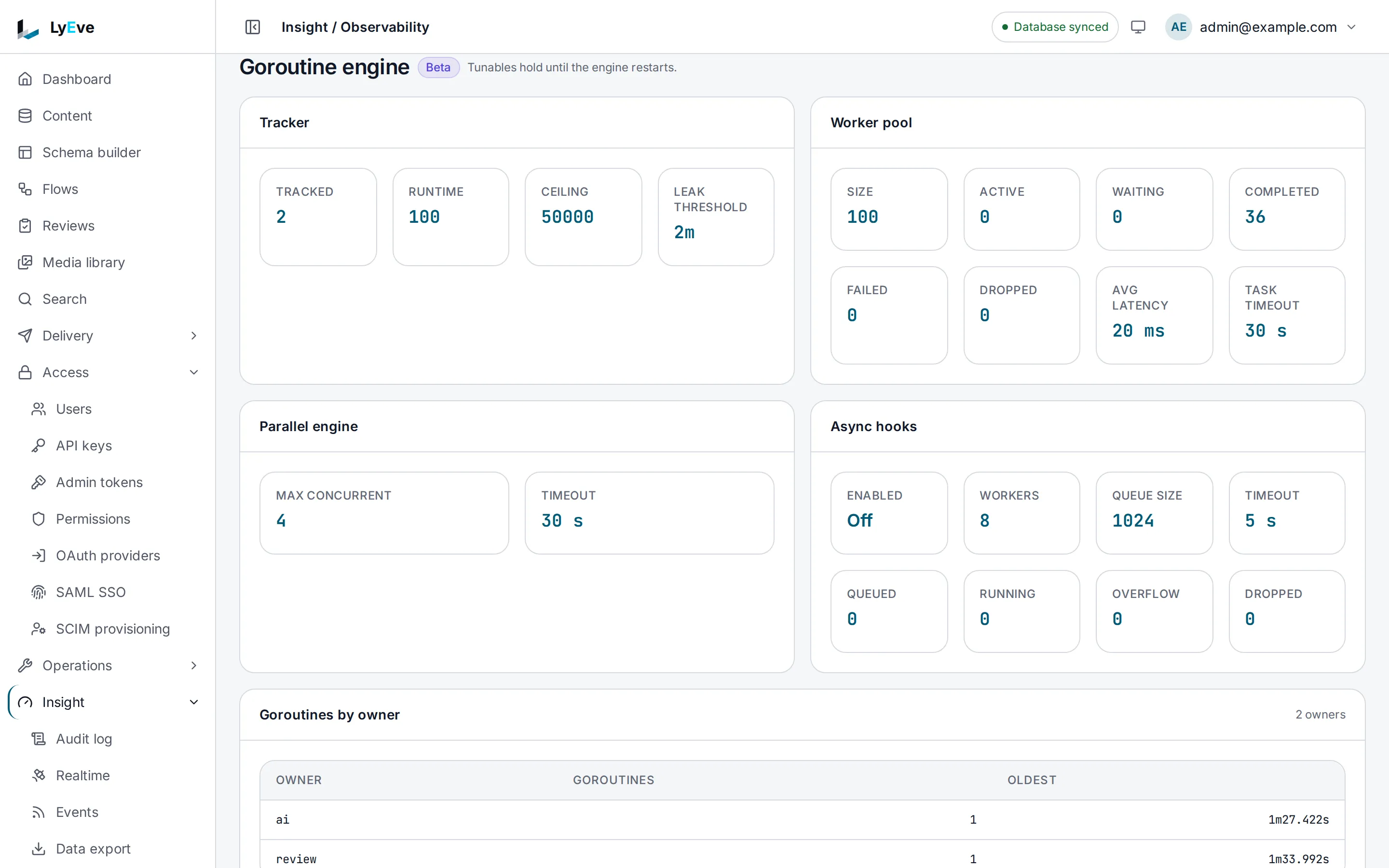
Section titled “In the admin console”Open Insight > Observability and find Goroutine engine. Tracker, Worker pool, Parallel engine and Async hooks give the same numbers as the reads below, and Goroutines by owner lists the live tasks of each feature with the age of the oldest. Below them, Resize the pool, Parallel engine and Async hooks change the settings with Apply. The section notes that a change holds until the instance restarts.
Try it
Section titled “Try it”You need an admin token in TOKEN. The
quickstart shows how to get one.
-
Read the worker pool:
Terminal window curl http://localhost:3001/api/admin/debug/goroutines/pool \-H "Authorization: Bearer $TOKEN"{ "size": 100, "active": 0, "waiting": 0, "completed": 3, "failed": 0, "dropped": 0, "avg_latency": "127.377427ms", "task_timeout": "30s" } -
Read the parallel engine:
Terminal window curl http://localhost:3001/api/admin/debug/goroutines/parallel \-H "Authorization: Bearer $TOKEN"{ "max_concurrent": 4, "timeout": "30s" } -
Read the async hook queue:
Terminal window curl http://localhost:3001/api/admin/debug/goroutines/async-hooks \-H "Authorization: Bearer $TOKEN"{ "enabled": false, "workers": 8, "queue_size": 1024, "timeout": "5s", "queued": 0, "running": 0, "overflow": 0, "dropped": 0 } -
As a super admin on a license with
goroutine-engine-pro, grow the pool. The answer is the new state. Without the license it is402:Terminal window curl -X PUT http://localhost:3001/api/admin/debug/goroutines/pool \-H "Authorization: Bearer $TOKEN" \-H "Content-Type: application/json" \-d '{"size": 200}'
Read the numbers
Section titled “Read the numbers”| Field | Means |
|---|---|
Pool active, waiting | Tasks running now, and tasks waiting for a free worker. A steady waiting above 0 means the pool is too small. |
Pool failed | Tasks that ran and failed. A bigger pool does not help. |
Pool dropped | Tasks that never started, because their caller gave up before a worker was free. Read this before you raise the size. |
Async hooks overflow | Hooks that found the queue full and ran inside the request instead. |
Status by_owner | Live tasks and the oldest one's age, per feature. A count that only grows is a leak. |
Change a setting
Section titled “Change a setting”Writes need a super admin and a license with goroutine-engine-pro. The
pool write needs size. In the other two, a
field you leave out keeps its value. Durations are strings such as 30s or
5m. Each write answers the new state and is
recorded in the audit log with the values before and after.
| Request | Body | Allowed values |
|---|---|---|
PUT /api/admin/debug/goroutines/pool | {"size": 200} | size from 1 to 4096. |
PUT /api/admin/debug/goroutines/parallel | {"max_concurrent": 8, "timeout": "30s"} | max_concurrent from 1 to 1024. timeout above 0, at most 1h. |
PUT /api/admin/debug/goroutines/async-hooks | {"workers": 8, "queue_size": 1024, "timeout": "5s", "enabled": true} | workers from 1 to 1024. queue_size from 1 to 65536. timeout above 0, at most 10m. |
Growing the pool lets waiting work start at once. Shrinking it lets running work finish. Switching async hooks on or off applies from the next hook.
A change made over the API is lost on restart, so set the matching variable under settings too when it should last.
Without the license
Section titled “Without the license”Every view keeps working. The changes do not:
- Each
PUTanswers402withpayment_required, namingfeature:goroutine-engine-pro, and nothing changes. GET /api/admin/debug/goroutines/tuninganswers{"licensed": false}, so a script can check before it writes.- The four variables under settings are ignored. The instance
logs a warning naming
goroutine-engine-proand starts with the defaults: a pool of 100 workers, after-save hooks run in order inside the request, and features warm their caches and stop one at a time.
When a license lapses, the running settings stay until the next restart, and
the next write answers 402.
Settings
Section titled “Settings”These set the starting values. The first four need a license with
goroutine-engine-pro. Without it they are ignored with a warning in the log,
and the defaults apply. With it, a value that does not parse or is out of
range is logged and skipped, and the others still apply.
| Variable | What it does | Default | Needs |
|---|---|---|---|
GOROUTINE_ENGINE_ENABLED | Warms feature caches and stops features in parallel, instead of one at a time. | false | goroutine-engine-pro |
GOROUTINE_ENGINE_POOL_SIZE | Workers in the pool, from 1 to 4096. | 100 | goroutine-engine-pro |
ASYNC_HOOKS_ENABLED | Runs after-save hooks in the background from the start. | false | goroutine-engine-pro |
ASYNC_HOOK_TIMEOUT | How long one async hook may run. | 5s | goroutine-engine-pro |
DB_WARMUP_PARALLELISM | How many tasks the parallel engine runs at once. Must be positive. | 4 | Free |
A DB_WARMUP_PARALLELISM that does not parse, or is not positive, stops the
boot with a message naming the variable. Concurrency tuning runs on every install. If you set
LYEVE_PLUGINS to choose which features start, include goroutine-engine in
it. See licensing and tiers.
Routes
Section titled “Routes”| Method | Path | Who | Answers |
|---|---|---|---|
GET | /api/admin/debug/goroutines/status | Admin | total, runtime_total, by_source, by_owner, max_goroutines, leak_threshold. |
GET | /api/admin/debug/goroutines/pool | Admin | size, active, waiting, completed, failed, dropped, avg_latency, task_timeout. |
GET | /api/admin/debug/goroutines/parallel | Admin | max_concurrent, timeout. |
GET | /api/admin/debug/goroutines/async-hooks | Admin | enabled, workers, queue_size, timeout, queued, running, overflow, dropped. |
GET | /api/admin/debug/goroutines/tuning | Admin | licensed: whether the writes below are allowed. |
PUT | /api/admin/debug/goroutines/pool | Super admin, with goroutine-engine-pro | Resize the pool. |
PUT | /api/admin/debug/goroutines/parallel | Super admin, with goroutine-engine-pro | Change the parallel engine. |
PUT | /api/admin/debug/goroutines/async-hooks | Super admin, with goroutine-engine-pro | Change async hooks. |
Errors
Section titled “Errors”| Status | Message |
|---|---|
400 | invalid JSON, also sent for a field the route does not take. |
402 | payment_required, naming feature:goroutine-engine-pro, on any write without the license. |
409 | async hooks need a worker pool, and this install runs without one |
422 | nothing to change: set max_concurrent or timeout (or workers, queue_size, timeout or enabled) |
422 | timeout must be a duration such as 30s |
422 | A value outside the allowed range. The message states the range. |
Related
Section titled “Related”- Request profiling: goroutine counts, CPU profiles and the slowest endpoints.
- Scale and tune: load shedding, replicas and the connection pool.
- Troubleshooting: logs, request ids and tracing.